
Displaying items by tag: Nicholas Gentile
Choir discoveries--notes from a lyricist
What was I looking for in my 'choir tour' of England, Scotland and Ireland in April and May this year? I heard over 30 choirs, the most illuminating experience being 3 days of the Cork International Choir Festival. I wanted to study the words these unique groups of people were singing and to discover, if I could, what moved them and made them want to sing each set of lyrics. What was it about the particular words and music together that brought them the greatest satisfaction and commitment, and formed the closest rapport with the audience?
The simplest answer is to give you the lyrics of the song "Points and Lines"--a poem by Aldous Huxley. Set to mesmerising music by much awarded composer Timothy Doyle (b. 1991) and sung with tender sensitivity by Chamber Choir Ireland in the Cathedral of St Mary an St Anne on 2 May 2026, this stood out for me because of three elements: aurally it is a beautiful poem in itself; it explores one clear idea; its power comes from an extended metaphor. One could feel that the composer, the choir and the choir master Gabriel Crouch were profoundly moved by this contemplative piece. So was I. And that's the main thing I learned on the choir tour--there needs to be a unity of feeling and purpose for a choir to really reach their audience.
POINTS AND LINES
Instants in the quiet, small sharp stars,
Pierce my spirit with a thrust whose speed
Baffles even the grasp of time.
Oh that I might reflect them
As swiftly, as keenly as they shine.
But I am a pool of waters, summer-still,
And the stars are mirrored across me;
Those stabbing points of the sky
Turned to a thread of shaken silver,
A long fine thread.
Aldous Huxley
At present I'm working on a series of 6 tone poems entitled Ocean Australis, with composer Nicholas Gentile.
Voices of the sea

I am writing Death in an Ideal Landscape for Sapere Books at the moment, the fourth title in the Victor Constant Mysteries. I am also working on a big choral work with Nicholas Gentile, which requires me to research the Timor and Arafura seas, first-hand. Last Friday's sunset cruise in a catamaran on Darwin Harbour was dramatic. After sunset, a storm whipped itself up and we were followed by a rainbow, flanked by both sheet and forked lightning, and drenched by horizontal rain. All in the cause of art. Loved it!
My first film review
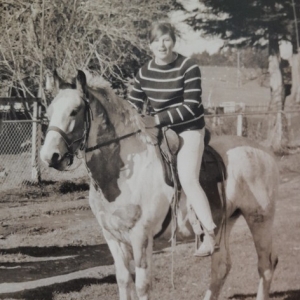
The picture was taken in the country near Gisborne, New Zealand, in the sixties. I mean, it’s so tell-tale: when else would a teenager on holiday sweep her hair up and choose white jeans to ride a horse? This was at the end of my last year at school, a period in which I kept the one and only diary of my life, which lasted until November 1966.
Rediscovering the diary, I came across what I realise is my first film review. It is interesting (at least to me, now I’m writing screenplays) to note that it isn’t a fan rave about Peter O’Toole (though I adored him, particularly for his Henry II opposite Richard Burton’s Becket) but a writer’s assessment of how the film is put together. Here it is verbatim, with all its sins upon its head.
‘Today I went with Sue Flanigan to Lord Jim. Starring Peter O’Toole. In this I missed a real speech, too many incoherent half-sentences. True, Jim was not talkative in the book. Too coiled up inside. The real flow of the narrative, picturesque, arresting, penetrating, came from Marlow in the book. In the film a Jack Hawkins Marlow gave a few conventional, regretful remarks and left Jim to his tortured silence. Unfortunate, the film desperately needed Marlow. Even a direct clash with hostile forces and a dramatic rescue soon after Jim’s arrival failed to speed up the action before Jim’s seizure of power in Patusam. Either the film script needed a Marlow or the plot must be thickened. Richard Brooks did neither. He was happy to tamper by removing but not by addition. He retained some hideously difficult scenes (to act, I mean) and shifted characters so that the scene could be filled with more than just a man and his thoughts in many parts. Brooks retained quite well the theme of Tuan Jim. It was simple enough anyhow. Simplicity was perhaps the difficulty. After all, Conrad originally intended it to be a short story, didn’t he? It widened into a deeper personal narrative and almost a dissertation on men and the fantastic complications which their sense of ‘honour’ can achieve in their lives. Much of it, let’s face it, is padding. A seaman’s yarn, with deep and engrossing stories all thrown in, almost as asides. Jim’s love of the girl. Dain Waris. Stein. Although Stein and the villain are necessary figures. The book rambles unashamedly but the reader has the chance to glance back and pick up the thread of the theme, reread the final conversations with the villain of the piece (excuse the music-hall bit but what was the man’s name—Brown?). The book triumphantly emerges as a whole.
‘The film was slow. It had to be because there was no Marlow to weave a texture of words over the bare thread of the action. The padding, the relationships between Jim and the others proved unattainable in a film if used in Conrad’s original form. There were relationships not of action but of feeling. They were irrepressible, particularly by Jim.
‘Perhaps Peter O’Toole did play Jim as a “neurotic bore”. If so it was not his fault. Or Joseph Conrad’s. The whole idea should have been scrapped in the first place. Lord Jim is simply not a film. It’s not spectacular enough to pass off as a "great epic" and earn millions by catering to vulgarity. It needs sensitivity and a sort of 6-dimensional approach, a panorama of emotion and exposition, I don’t know, and I suppose you couldn’t have Marlow droning away – genius or a new medium to put it anywhere except on the pages of Conrad’s book. Therefore it’s not an "art" film either. It’s an irritating middling.’
Dear reader, was I dreaming already of Émilie & Voltaire in my desire for six filmic dimensions? It could be said our streamed cinematic opera will provide them. Emotion: Nicholas Gentile's divine music, the jealous lovers, the passionate lyrics. Exposition: the authentic setting of Cirey in France, a true historic discovery, a woman’s groundbreaking contribution to science.